


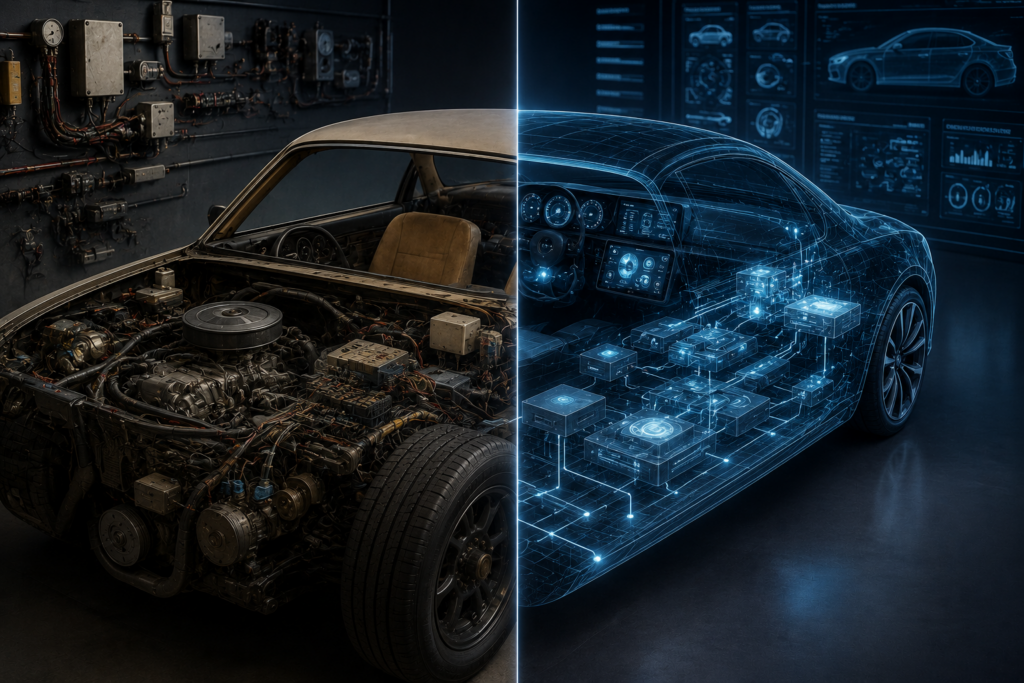
For most of automotive history, the driving experience was defined by direct mechanical relationships. A pedal moved a cable, a steering wheel turned a column, and a throttle opened a physical valve. The driver was always one step away from the machine itself—close enough to feel every vibration, resistance, and response.
Today, that relationship has changed fundamentally. Modern vehicles are increasingly defined not by mechanical linkage, but by digital interpretation. Inputs are now signals. Decisions are made by software. And increasingly, the “car” is as much a computing platform as it is a mechanical system.
We are now firmly in the era of the analog car’s decline.
From Mechanical Logic to Software Mediation
The shift didn’t happen overnight. Early electronic systems were simple enhancements—fuel injection replacing carburettors, ABS assisting braking, electronic power steering reducing driver effort.
But over time, these isolated systems began to merge into something more complex: integrated electronic control units (ECUs) managing entire vehicle functions.
Instead of individual mechanical responses, modern cars rely on networks of ECUs communicating across digital buses. Steering, braking, throttle response, suspension stiffness, and even sound design are increasingly governed by software logic.
What this means in practice is simple: the car no longer reacts directly to the driver. It interprets the driver’s input, processes it, and then decides how to respond.
The Rise of Centralised Vehicle Computing
One of the most significant developments in automotive engineering is the move from distributed ECUs to centralised computing architectures.
Older vehicles might have dozens of independent control units—one for engine management, another for braking, another for climate control. Modern platforms increasingly consolidate these into high-performance central computers.
This shift brings several advantages:
-
Faster communication between systems
-
More efficient software updates
-
Greater integration of safety features
-
Improved data collection for diagnostics
It also mirrors developments in consumer technology, where smartphones replaced fragmented devices by centralising functionality into a single processor-driven platform.
Cars are now following the same trajectory.
Drive-by-Wire: The Disconnection Between Input and Mechanism
Perhaps the clearest example of digital dominance is “drive-by-wire” technology.
In traditional systems, steering and acceleration were mechanically linked. In modern systems, those inputs are often converted into electronic signals. The steering wheel no longer physically dictates wheel angle in a direct mechanical sense—it instructs a system that decides how to apply steering based on speed, traction, and stability data.
Similarly, throttle input is no longer a direct opening of the engine’s air intake. It is a request interpreted by the engine management system.
This allows for precision and safety interventions, but it also fundamentally changes the driving experience. Feedback becomes filtered. Responses become algorithmically shaped.
Software Defines the Driving Character
In earlier generations of cars, driving feel was primarily determined by hardware: engine size, suspension setup, gearbox type.
In modern vehicles, software plays an increasingly dominant role.
Drive modes such as “Comfort”, “Sport”, or “Eco” are not just marketing labels—they actively change:
-
Throttle mapping
-
Steering weight
-
Suspension damping (in adaptive systems)
-
Gearshift behaviour
-
Regenerative braking intensity in EVs
This means the same physical car can behave like multiple different vehicles depending on software configuration. The personality of the car is no longer fixed—it is programmable.
Electric Vehicles Accelerate the Transition
Electric vehicles have pushed this transformation even further.
Without traditional combustion engines, EVs rely almost entirely on software to define performance characteristics. Acceleration curves, torque delivery, and even artificial driving sounds are digitally generated.
This creates a fundamentally different architecture: fewer moving parts, but significantly more computational complexity.
Tesla, for example, popularised the idea that a vehicle is a continuously evolving platform. Over-the-air updates can change performance, efficiency, and even user interface behaviour long after purchase.
In this environment, the car becomes less of a static object and more of a software ecosystem.
The Loss of Mechanical Transparency
One of the most debated consequences of this shift is the loss of mechanical transparency.
In an analog car, a driver could often sense what the machine was doing. Engine load, gearbox engagement, and steering resistance provided direct feedback.
In a digitally mediated system, that feedback is filtered. Stability systems intervene before slippage is felt. Steering assistance adjusts continuously. Torque delivery is smoothed to prevent inefficiency or instability.
The result is a safer, more controlled driving experience—but also one that is less physically communicative.
For enthusiasts, this represents a subtle but significant change in how driving feels. For everyday drivers, it often goes unnoticed.
Data as the New Automotive Core
Modern vehicles are also becoming data-generating systems.
Sensors throughout the car continuously monitor:
-
Driver behaviour
-
Road conditions
-
Mechanical health
-
Energy consumption
-
Environmental factors
This data is used not only for immediate control but also for predictive maintenance, insurance modelling, and long-term optimisation.
In effect, the car is no longer just responding to the road—it is learning from it.
Design Implications: Interiors Without Buttons
The digital shift has also transformed automotive interiors. Physical buttons are disappearing, replaced by touchscreen interfaces and voice control systems.
This reflects a broader design philosophy: fewer mechanical components, more software-driven interaction.
However, this transition is not without controversy. Many drivers still prefer tactile controls for critical functions, arguing that touchscreens introduce unnecessary distraction and reduce intuitive usability.
Manufacturers are now experimenting with hybrid approaches, reintroducing select physical controls while maintaining digital flexibility.
The New Role of Automotive Identity
As cars become more software-defined, identity is increasingly shaped by configuration rather than mechanical uniqueness.
A vehicle’s character is now influenced by:
-
Software version
-
User settings
-
Digital features enabled or disabled
-
Personalised driving profiles
This mirrors wider trends in consumer technology, where identity is shaped by customisation rather than ownership alone.
Even external elements of vehicle identity are evolving within this context. Personalisation now extends beyond performance and into visual and regulatory presentation, where details such as plate styling and finishing are part of a broader design language. In this space, brands like Number 1 Plates sit quietly within a larger movement towards refined, detail-oriented vehicle personalisation rather than purely mechanical modification.
Conclusion: A Redefined Relationship with the Machine
The analog car has not disappeared entirely, but it is clearly being phased out of mainstream automotive design. In its place is a new kind of vehicle—one defined by code, computation, and continuous adaptation.
This shift brings undeniable advantages: improved safety, efficiency, and flexibility. But it also changes something more intangible—the directness of the driving experience itself.
Where once a driver interacted with a machine, they now interact with a system that interprets, moderates, and refines every input.
The car is no longer just engineered. It is programmed.