



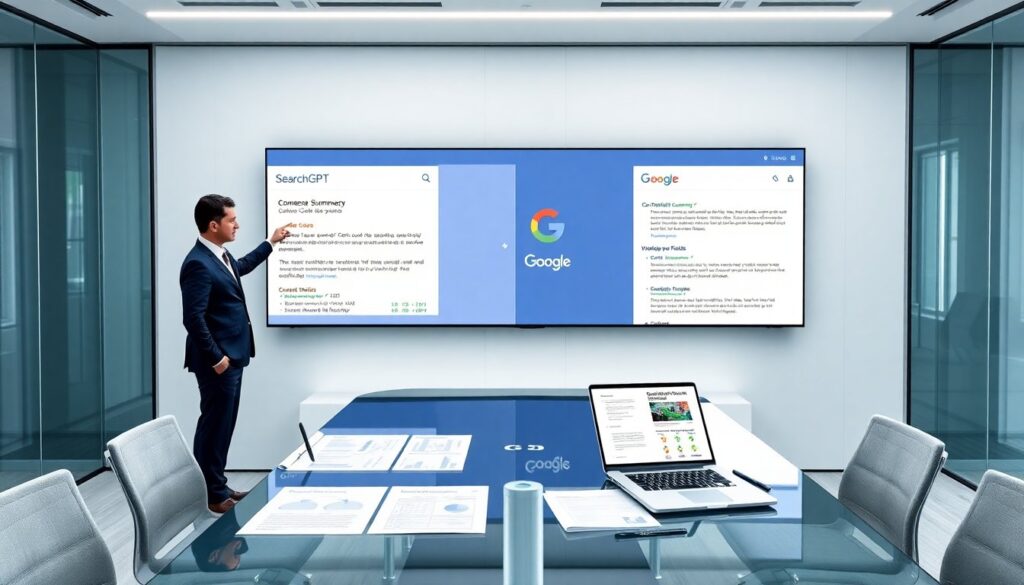
Will SearchGPT replace Google siliconinsider is the question many read today. The phrase frames the debate about AI search. The article defines SearchGPT. It compares features, limits, and market forces. It gives clear points readers can use to judge change in 2026.
Key Takeaways
- SearchGPT is an AI-powered search system offering concise, generated summaries, differing from Google’s traditional link-based approach.
- While SearchGPT enhances quick fact-finding with multi-step queries, it faces challenges like accuracy, cost, and the need for frequent data updates.
- Google Search remains strong due to its continuous web indexing, broad topic coverage, and established monetization through ads.
- Publishers must adapt by providing clear citations and structured data to ensure visibility within AI-driven search results.
- Search strategists should optimize content for AI citation and maintain traditional SEO tactics to balance discoverability.
- SearchGPT will coexist with Google, reshaping user behavior and search strategies without fully replacing Google in the near future.
What SearchGPT Is And How It Differs From Traditional Google Search
SearchGPT is an AI-first search system that returns concise answers and generated summaries instead of long lists of links. It ingests documents, models user intent, and synthesizes responses. Google Search returns ranked links, snippets, and rich panels. Google indexes the web and shows signals like backlinks and freshness. SearchGPT uses large language models to generate prose and cite sources. SearchGPT emphasizes conversational queries and follow-up questions. Google emphasizes breadth, freshness, and navigational tasks.
SearchGPT supports multi-step queries and can combine facts from multiple pages into a single reply. Google supports topic exploration and discovery across many sites. SearchGPT can reduce time-to-answer for factual questions. Google can direct users to diverse perspectives, original authors, and publishers. SearchGPT can hallucinate or misattribute facts when its training data lacks updates. Google can miss synthesized context but it shows the original source for verification.
SearchGPT changes user workflow. A user asks a question and the model answers. A user then asks a clarification and the model refines the reply. A publisher must adjust by offering structured data and clearer citations to remain visible. An SEO specialist must test prompts and provide content that models can cite. A reader must still validate claims by following source links. The phrase will searchgpt replace google siliconinsider reflects curiosity about whether AI summaries will fully replace link-based navigation. Both systems coexist while publishers adapt and users choose trade-offs.
Technical, Business, And User Limitations That Prevent Immediate Replacement
SearchGPT shows strong capabilities, but several limits stop it from replacing Google instantly. Models require large compute and steady data updates. SearchGPT models need frequent retraining or live retrieval to stay current. Google maintains a global crawl and index that updates continuously. SearchGPT models face cost-per-query that can scale quickly for millions of users. Google spreads costs across ad revenue and cloud services.
SearchGPT must address accuracy and citation. Models can generate plausible but wrong statements. SearchGPT needs reliable source attribution before users can trust it for news, finance, or health. Regulations and liability concerns will slow full adoption in sensitive areas. Search companies will need audit trails, verifiable citations, and user controls before regulators approve broad use.
SearchGPT also faces user behavior limits. Many users prefer quick access to many sources, not a single synthesized answer. Power users and researchers value original pages, data tables, and primary documents. Advertisers and publishers also drive search economics. SearchGPT requires a business model that compensates publishers when models use their content. Google already monetizes search with ads and partnerships.
SearchGPT must solve scale, cost, accuracy, and business models to match Google’s reach. The article notes that other AI uses exist in parallel. For example, a major sports operator uses AI to flag harmful behavior in gambling contexts, which shows real-world AI limits and responsibilities in live systems, as reported in an ESPN betting story. That example shows AI can work but it also shows oversight needs.
SearchGPT will compete, but it will not replace Google overnight because of these technical, business, and user constraints.
What SearchGPT’s Rise Means For Users, Publishers, And Search Strategy
Users will gain faster summaries for simple tasks and personalized answers for routine queries. Users will still rely on source links for verification and deep research. Users will compare answers and follow cites when accuracy matters.
Publishers will need to change formatting and metadata. Publishers must provide clear citations, structured data, and licensed access if they want AI systems to use their content directly. Publishers that offer machine-readable summaries increase the chance that a model cites them. Publishers that hide paywalled data may lose visibility when models prefer open sources.
Search strategists must test prompts and track which pages models cite. SEOs will measure both raw traffic and citation frequency inside AI answers. SEOs will adapt by adding concise, factual blocks that models can quote. SEOs will keep classic link-building because models still rely on source credibility signals.
Product teams will design hybrid experiences. A product can combine SearchGPT’s syntheses with Google-style link lists and verification tools. A product can show an AI answer with a short list of source links and a toggle to view the original pages. A product can also surface confidence scores and update timestamps to help users judge timeliness.
Companies will face licensing decisions. Some companies will license content to AI platforms. Others will block crawlers or require paid access. Those choices will reshuffle publisher revenue and influence which sources models use.
SearchGPT’s rise will change attention patterns, but it will not eliminate the need for original reporting, data, and verification. Users will demand transparency and links. Publishers and strategists will adapt their content and measurement to remain discoverable by both AI systems and traditional search engines.

