
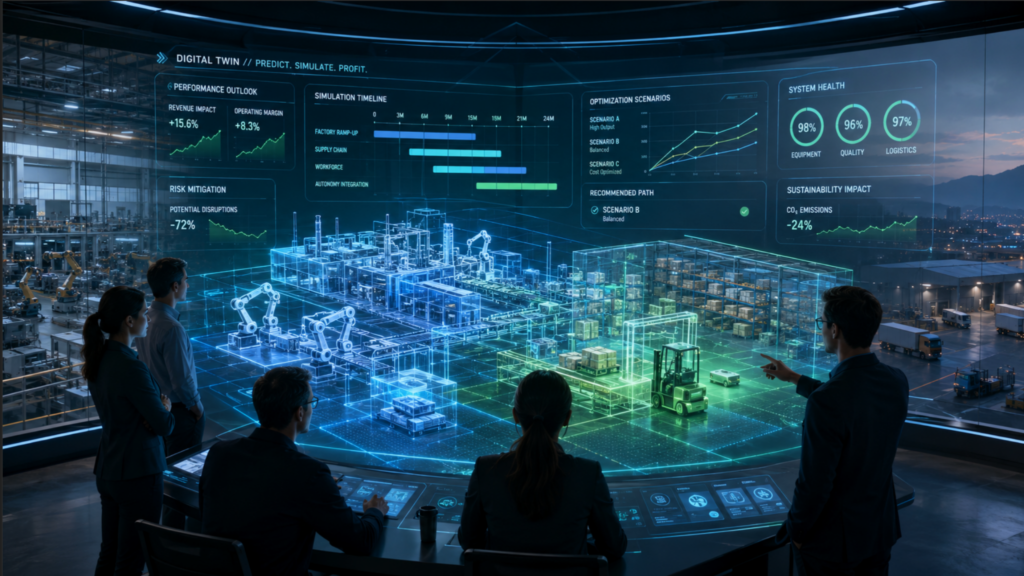
A lot of businesses used to depend on waiting. A company built a factory line, opened a warehouse, or launched a product, then watched to see what went wrong. NVIDIA is pushing a different idea. It wants companies to test tomorrow before tomorrow arrives. On its Omniverse pages, NVIDIA says the software is built for industrial digital twins and physical AI simulation. In simple terms, that means a business can make a virtual copy of a real place or system, then study what may happen before spending money in the real world.
A model now comes before the machine
This shift matters because business gets more expensive when every lesson has to be learned the hard way. If a company can test a warehouse, a robot path, or a factory layout in a simulated space first, it can catch weak spots early. NVIDIA’s own material says Omniverse libraries support sensor simulation, real time rendering, and advanced physics for digital twins and robotics simulation. That means the model is not only a picture. It is a working test space.
That is where the new economy around simulation starts to make sense. The sale is no longer just hardware. The deeper sale is certainty, or at least a better guess. Companies are paying for the chance to see problems sooner, train systems faster, and make fewer costly mistakes later. That is my reading of NVIDIA’s current push, and it fits the way the company and its partners describe digital twins as tools for design, testing, and optimization before real deployment.
Prediction becomes a business skill
What used to sound like science fiction now looks more like everyday planning. NVIDIA’s recent materials keep returning to the same idea: simulate first, then build. At GTC 2026, the company described physical AI as systems trained and validated in grounded simulated environments long before they reach factory floors. That tells us something important. The companies that profit may be the ones that get best at calculating likely outcomes before the real world forces the answer.
Partners are turning theory into tools
This is not just a pitch deck story. ABB announced in March 2026 that it is integrating NVIDIA Omniverse libraries into RobotStudio to create RobotStudio HyperReality for industrial use. NVIDIA’s own blog said the product is drawing strong interest and cited early pilots including Foxconn and Workr. Another NVIDIA post said ABB’s wider simulation platform is used by more than 60,000 engineers globally.
The same pattern shows up in other industries. NVIDIA said KION is using Omniverse and a physical AI powered digital twin architecture to create warehouse twins for autonomous forklifts, while factory partners at Hannover Messe were using digital twins to test robot fleets and process changes. The business logic is plain: model the risk first, then move with more confidence later.
Simulated worlds are starting to feel normal
That may be the biggest cultural shift of all. A digital twin once sounded like a special tool for a niche lab. Now it is becoming part of ordinary business language. A company can study movement, energy, timing, and flow inside a virtual space the same way a person might glance across very different corners of the internet and stumble past https://dragonslots.com/ without even pausing. The wider point is not the link itself. It is that screen life now holds many parallel worlds, and businesses are learning to trust one of those worlds enough to plan real money around it.
This is really about profit through foresight
NVIDIA’s recent DSX material makes the money angle even clearer. The company said simulation can cut AI factory deployment time from months to days and help ensure day one performance, while also accelerating time to first revenue. That is the quiet promise sitting underneath all the talk about digital twins. The value is not only technical beauty. The value is earlier clarity, faster rollout, and fewer bad surprises.
That may be the best way to describe the new NVIDIA economy. It is built on the idea that tomorrow can be read, tested, and shaped before it becomes real. Not perfectly, and not without error, but well enough to matter. The companies that get good at simulation are not only building machines. They are buying better odds on the future, and in business that can be worth a great deal.