



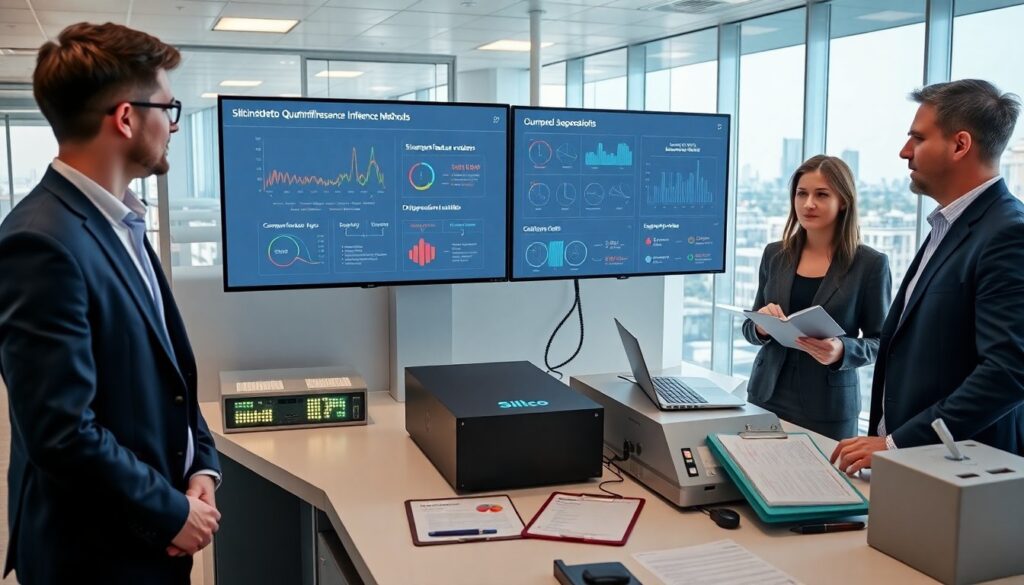
Latest archives silicon-insider enable efficient state estimation in hybrid quantum-classical systems. The methods reduce latency and improve accuracy for streaming data. Teams apply these methods to control tasks, prediction pipelines, and sensor fusion. The introduction gives practical context and sets expectations. Readers will see algorithms, workflows, and deployment tips.
Key Takeaways
- Silicinsidrstaccato quantum inflorescence inference methods enable faster and more accurate state estimation by combining sparse quantum feature maps with classical inference models.
- These methods reduce sample counts and postprocessing costs, making them ideal for low-latency, streaming data applications like sensor fusion and short-horizon control.
- The inference workflow involves preprocessing quantum measurements, compressing features, and running lightweight classical predictors optimized for speed and stability.
- Effective noise management and latency control require calibration, optimized linear algebra operations, and pipelining of quantum reads with preprocessing.
- Operational best practices include using compact models, automating calibration, logging lightweight diagnostics, and isolating failure modes to ensure robust deployments.
- Real-world applications like sports analytics and electronic line calling demonstrate how domain-specific demands influence the design and prioritization of silicinsidrstaccato quantum inflorescence inference methods.
What Silicinsidrstaccato Quantum Inflorescence Is And Why It Matters
Silicinsidrstaccato quantum inflorescence inference methods refer to a class of algorithms. They combine sparse quantum feature maps with short-time stochastic updates. The approach treats quantum outputs as high-dimensional features. Then classical models perform inference on those features. Practitioners use the phrase to describe systems that stream quantum measurements into compact predictors.
The value lies in practical gains. The methods reduce the sample count per decision. They also lower postprocessing costs. Teams report faster end-to-end decisions when they adopt silicinsidrstaccato quantum inflorescence inference methods for low-latency tasks. The methods suit applications that require repeated short inferences rather than long batch training.
Architecturally, the system has three parts. A quantum frontend generates feature vectors. A conversion layer compresses those vectors. A classical inference module outputs labels or continuous estimates. The flow keeps latency low. The flow also isolates quantum noise to the frontend, which simplifies debugging.
Engineers choose this approach when hardware yields few qubits but frequent reads. They favor it for sensor fusion, short-horizon control, and prediction markets that need quick updates. The keyword appears in model descriptions and design docs. Teams use clear metrics to judge improvements: inference time, error rate, and throughput. These metrics show where silicinsidrstaccato quantum inflorescence inference methods matter most.
Core Inference Algorithms And Workflows
Core algorithms adapt common inference patterns to quantum feature inputs. A typical workflow starts with preprocessing. The system normalizes raw measurement streams. It then applies a quantum kernel or feature extractor. Next the workflow compresses features with projection or hashing. Finally a classical predictor runs fast linear or shallow nonlinear models.
Common algorithm choices include kernel ridge regression, sparse logistic regression, and lightweight neural nets. Teams select models that use few parameters. They avoid deep networks for per-inference speed. The models train on labeled traces that pair quantum outputs with ground truth. Training often uses gradient-free optimizers or small-batch gradient descent. The goal is stable generalization with minimal compute.
For streaming deployment, engineers adopt incremental updates. The system ingests batches and applies online updates to model weights. This step keeps models current without full retraining. They also apply drift detection to trigger full retraining only when performance drops. The pattern scales to distributed setups where multiple edge nodes share compressed feature summaries.
Designers also tune the quantum frontend. They pick feature maps that separate relevant classes while keeping readout simple. They reduce measurement overhead by choosing fewer basis rotations. They use calibration runs to map quantum noise patterns into model priors. Together, these choices improve the effective signal-to-noise ratio.
Practitioners who move from prototypes to production often document the flow. They log per-step latency, error, and resource use. They use these logs to select which parts of silicinsidrstaccato quantum inflorescence inference methods need optimization.
Implementation Challenges, Performance Tips, And Best Practices
Engineers face three broad challenges when they carry out silicinsidrstaccato quantum inflorescence inference methods: noise management, latency control, and validation. Noise management requires careful calibration. Teams perform repeated calibration sequences and capture noise covariance. They then fold that covariance into the compression step. This process reduces false confidence in outputs.
Latency control requires lightweight postprocessing. Teams prefer linear-algebra libraries optimized for edge CPUs. They also pipeline quantum readout with preprocessing to hide I/O wait. Where hardware supports it, they batch small groups of reads to amortize overhead. These steps lower per-inference time and raise throughput.
Validation demands realistic test data. Teams build test benches that replay device traces under varying loads. They measure end-to-end metrics and compare them against offline baselines. The team then uses those baselines to set deployment gates.
Operational tips for robust deployments follow.
- Use compact models. Compact models run faster and fail more predictably under load. They also make drift detection simpler.
- Log lightweight diagnostics. Log a small set of features, latencies, and final scores. These logs speed troubleshooting and keep storage low.
- Automate calibration runs. Schedule short calibration cycles to refresh noise priors. Automation reduces manual work and keeps models stable.
- Isolate failure modes. Route faulty reads to a sandbox that does not affect main predictions.
Real projects show that domain context matters. For example, sports systems that adopt AI assistants change their inference patterns when data frequency increases. Fox Sports describes AI features that combine live scores and stats to serve fans, which highlights how domain needs shape inference design. The Wimbledon move to electronic line calling also shows how real events force fast, reliable inference: such deployments stress low-latency pipelines and confirm why teams prioritize latency and validation in silicinsidrstaccato quantum inflorescence inference methods.

