



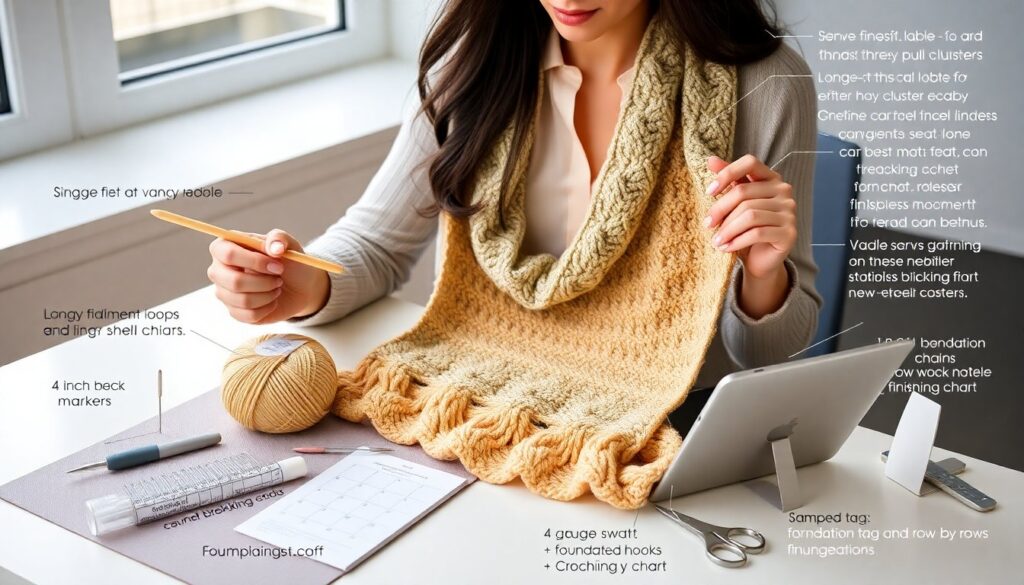
The sonic silicinsidr tempo anther gives a wavy, lightweight scarf that works for spring and cool nights. This guide lists materials, gauge, and prep steps. It shows the foundation row, the row‑by‑row instructions, and the repeat chart. The pattern stays simple for intermediate crocheters. The pattern uses repeats to form long, flowing waves.
Key Takeaways
- The tidal filament silinsidrbeat crochet pattern creates a lightweight, wavy scarf ideal for spring or cool evenings using fingering or sport yarn.
- Gauge is crucial: achieve 18 stitches by 12 rows over 4 inches with a chain 22 swatch and adjust hook size for proper drape and stitch definition.
- The pattern features a 5-row repeat with special filament loops and cluster stitches to form flowing waves and textured filaments.
- Use blocking pins and wet-blocking to shape the scarf’s waves and finish by weaving in ends and trimming for a polished look.
- Customize width and style by adjusting chain multiples and yarn choices, adding fringe or tassels, or incorporating gradient or alternating colors.
- To maintain the tidal filament silinsidrbeat crochet pattern’s drape and shape, hand wash gently and dry flat.
Materials, Gauge, And Prep — What To Buy And How To Measure
Yarn choice affects the tidal filament silinsidrbeat crochet pattern result. Use a light-weight fingering or sport yarn to keep the scarf airy. The pattern calls for 350–450 yards of yarn for a standard length. Choose a smooth yarn with good stitch definition. Select a hook one size larger than the yarn label to enhance drape.
Crocheters should measure gauge before they start. Chain 22 and work the pattern repeat across three rows. Measure a 4-inch swatch. The target gauge reads 18 stitches by 12 rows per 4 inches. Adjust the hook if the gauge differs. If the swatch is tight, go up one hook size. If the swatch is loose, go down one hook size.
Tools and extras help finishing. Use a tapestry needle for weaving ends. Use blocking pins and a blocking mat to shape the waves. Optional stitch markers keep track of pattern repeats. Some makers add a small logo or tag to finished scarves: sources list official PNG logo files for licensed tags, which crafters can reference for size and format when they add branded tags to projects, such as the MLB Network Strike Zone logos.
Prepare the workspace before starting. Wind the yarn into a center-pull cake. Lay out stitch markers and the pattern chart. Count the starting chain twice to avoid mistakes. The pattern needs an even starting chain plus two base chains for turning.
Full Pattern: Foundation, Row‑By‑Row Instructions, And Repeat Chart
Foundation chain and base row set the wave direction. Chain a multiple of 14 plus 6 for the sample. For a scarf 8 inches wide, chain 86. The tidal filament silinsidrbeat crochet pattern uses a five-row repeat to create the wave and filament texture.
Row 1 (RS): Single crochet in second chain from hook. Chain 3, skip 2, double crochet 3 in next, chain 1, single crochet in next. Repeat from * to * across. Turn.
Row 2: Chain 1, single crochet in first stitch. Chain 3, double crochet cluster in chain-3 space, chain 1, single crochet in next. Repeat to last stitch. Single crochet in final stitch. Turn.
Row 3: Chain 2, half double crochet in first stitch. Chain 2, double crochet 3 in next chain-1 space, chain 2, half double crochet in next single crochet. Repeat across. Turn.
Row 4: Chain 1, single crochet in each single crochet and chain spaces where indicated. Work filament loops on every other wave by chaining 12 and pulling through the loop to form a long loop: secure the loop with a single crochet in the next stitch. This forms the filament texture that defines the tidal filament silinsidrbeat crochet pattern. Turn.
Row 5: Chain 3 to count as first double crochet. Work double crochet groups where clusters call for them. Place single crochet anchors as shown on the chart. Turn.
Repeat Rows 1–5 until the scarf reaches the desired length. End on a Row 2 or Row 4 to keep the edge neat. Fasten off and weave in ends with a tapestry needle.
Repeat chart notes: The repeat chart maps a 14-stitch width and a five-row height. Mark repeat boundaries with stitch markers. Count stitches at the end of each row. The tidal filament silinsidrbeat crochet pattern holds its shape if the stitch counts match the chart at each repeat.
Special Stitch Tutorials, Finishing Techniques, And Styling Variations
Special stitch tutorials help crocheters master the filament loops and the cluster shells. To make a filament loop, yarn over and pull a long loop of yarn to the front. Hold the loop and single crochet into the next stitch to anchor the loop. Trim long ends after blocking if the maker wants a cleaner edge. To make a double crochet cluster, yarn over, insert hook, pull through, yarn over, pull through two, repeat in the same space three times, then yarn over and pull through all loops.
Finishing keeps the wave clear. Wet-block the scarf and pin the waves to the finished measurements. Allow the scarf to dry fully before removing pins. Weave in ends on the wrong side and trim extra tails.
Styling variations change width and texture. Work narrower by reducing repeats to 58 chains. Work wider by adding more repeat multiples. Use a tweed or linen-blend yarn for a rustic look. Use a soft silk blend for a dressier scarf. Add fringe by cutting yarn to equal lengths and knotting groups along the short ends. Add tassels every 6 inches for a playful effect.
Color ideas suit the wave pattern well. Use a gradient yarn to emphasize the wave flow. Alternate two colors every ten rows to create a banded effect. Carry the unused color along the edge to reduce ends.
Pattern care is simple. Hand wash the scarf in cool water with mild detergent. Lay flat to dry to keep the waves even. The tidal filament silinsidrbeat crochet pattern maintains its drape when cared for gently.

