



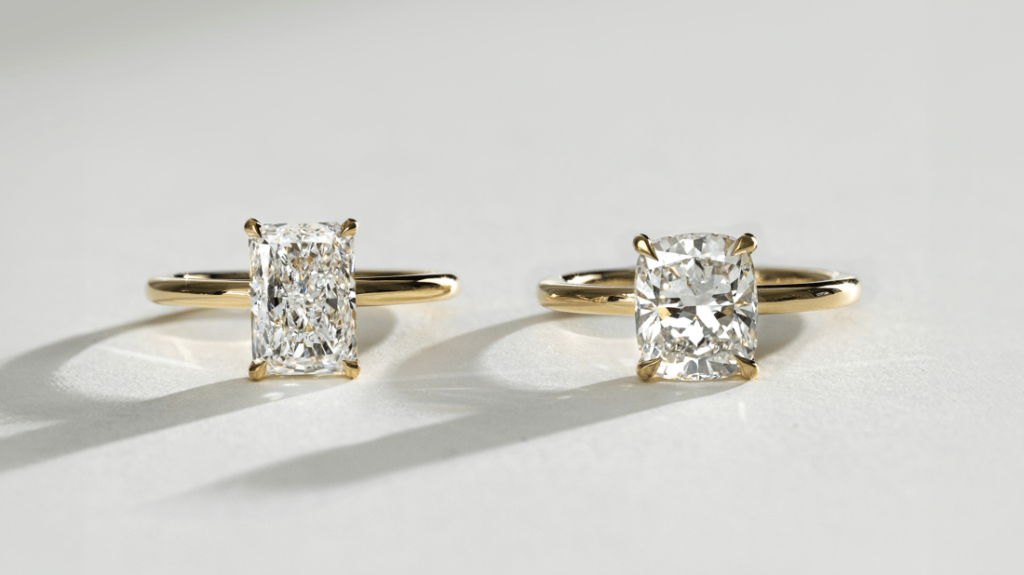
Hold a lab-grown diamond next to a mined one and you won't spot a difference. Neither will a jeweller with a loupe. Both are carbon, arranged in the same crystal lattice, both hard enough to scratch glass. The only real distinction is where the pressure and heat came from: a few billion years underground, or a machine in a lab that replicates those conditions in weeks.
Same Carbon, Different Origin Story
Mined diamonds form roughly 150 kilometres beneath the earth's surface, under conditions that took millions of years to line up. Lab-grown diamonds get there faster, using one of two methods: High Pressure High Temperature (HPHT), which mimics the crushing conditions of the mantle, or Chemical Vapour Deposition (CVD), which builds a diamond layer by layer from carbon-rich gas. Either way, the result is chemically and optically identical to a mined stone. Same refractive index, same hardness on the Mohs scale, same fire and brilliance under light. It's part of why more shoppers are starting with cut and setting rather than origin, browsing something like Cullen Lab diamond ring designs before they even get to the question of which growth method produced the stone.
That similarity is exactly why standard jewellery tools can't tell them apart. A thermal probe or a loupe checks for diamond versus imitation (moissanite, cubic zirconia, glass), not diamond versus diamond. You need something that reads growth patterns at a level no eye can reach.
Where the Detection Actually Happens
Gemological labs use a handful of specific tools to separate the two. Photoluminescence spectroscopy shines a laser at the stone and reads the light it emits back; mined diamonds and lab-grown ones absorb and release light differently depending on trace elements picked up during formation. Fluorescence imaging under UV light can reveal growth patterns unique to each method: HPHT stones often show a cross-shaped pattern, CVD stones tend to show striations running in one direction.
The most telling evidence sits in trace impurities. Natural diamonds pick up nitrogen unevenly over the millions of years they spend forming, which shows up as irregular colour zoning under magnification. Lab-grown stones, formed in a controlled environment over days or weeks, show far more uniform internal structure. Machines like De Beers' DiamondView or GIA's spectroscopy equipment pick this up in minutes, something no jeweller could do by eye even with decades of experience.
Every reputable lab-grown diamond also carries a laser inscription on the girdle, invisible without 10x magnification, stating its origin. It's a small mark, but it's the one piece of identification that doesn't rely on a lab test at all.
None of this detection technology exists to catch anyone out, by the way. It exists because buyers deserve to know exactly what they're purchasing, and because certification protects the value of both mined and lab-grown stones over time.
Why the Gap Keeps Shrinking
CVD growth times have dropped significantly over the past five years as reactor technology improves, and detection equipment has had to keep pace. Gemological labs update their reference databases constantly, because growers keep refining their processes. It's an arms race in the most low-stakes sense possible: one side gets better at making diamonds, the other gets better at reading them.
For anyone buying a diamond right now, the practical takeaway is simple. Ask for certification, whether the stone is mined or lab-grown. The paperwork is the only reliable answer, because the human eye stopped being useful in this conversation years ago.

